

 English
 عربى
عربىMotor Engineering — Appliance Design
DC Motor Variable Speed: A Working Guide for Designers and Buyers
Variable-speed DC motors deliver a wider speed window, quieter low-speed operation, and better partial-load efficiency — when the motor, driver, and thermal design are specified as one system.
A range hood manufacturer is testing a 120 V DC motor for a new kitchen line. The brief demands three extraction speeds, a strict low-speed noise limit, and a controller that holds speed as the filter loads up. In another lab, an air cooler producer wants a motor that can fall to one-third of rated speed for night running without overheating.
Both teams are asking the same question: how does DC motor variable speed actually work, and what belongs in the specification before the first sample ships? The answer, in short, is that speed follows voltage, torque follows current, and the controller decides how tightly the two are held. Efficiency, noise, and service life all depend on how well these three are matched.
What Makes a DC Motor Variable-Speed
In a permanent-magnet DC motor, speed is proportional to the voltage applied to the armature, while torque is proportional to armature current. Reduce the average voltage and the motor slows; raise it and the motor climbs toward its rated speed. That near-linear behavior is why DC motors are the natural base for variable-speed appliances — there is no rotating field to synchronize and no frequency inverter in the circuit.
There is a second half to the picture. Under load, every real motor slows slightly because of winding resistance and, in brushed designs, brush losses. An open-loop controller that only sets a voltage level cannot correct that droop. For fans and blowers, where a few percent of drift is invisible, open-loop operation is acceptable. For a range hood that must keep a minimum air volume, or an air cooler pushing air through wet pads, closed-loop control is worth the extra cost.
Voltage defines the speed window, current defines the torque, and feedback decides whether the motor keeps its promise when the load changes.
Three terms frame every conversation with a motor supplier:
- Speed range — the ratio of the lowest usable speed to the rated speed, often stated as 5:1 or 20:1. A wider ratio requires a driver designed for low-speed stability.
- Duty cycle — whether the motor runs continuously at minimum speed or only in short intervals. This determines the thermal design.
- Regulation — the speed drop from no load to full load at a fixed setting, expressed as a percentage. Closed-loop systems show far lower regulation than open-loop ones.
Main Ways to Control DC Motor Speed
Three control methods appear in production appliances. They differ in cost, efficiency, noise, and torque behavior.
Linear Voltage Control
A variable resistor or linear regulator lowers the voltage seen by the armature. The concept is simple and cheap, but the discarded energy becomes heat in the appliance and efficiency collapses at reduced speed. It suits ultra-low-cost fans, rarely a product that runs for hours.
Pulse Width Modulation
Pulse width modulation switches the supply fully on and off at a fixed frequency — typically 8 kHz to 25 kHz — and varies the duty cycle. The motor sees a lower average voltage while the switching device is either fully on or fully off, so driver losses stay small. PWM is now the standard method for DC motor variable speed, including brushless DC motors, because it combines efficiency with a wide controllable range.
Closed-Loop Feedback Control
Closed-loop control adds a speed sensor — a Hall sensor, an encoder, or a back-EMF detection circuit — so the driver compares actual speed with the commanded value and adjusts PWM in real time. The motor holds its speed when the impeller loads it, when a filter clogs, or when the supply voltage sags. Brushless DC motors rely on this electronic commutation anyway, which is why they offer a flat torque curve across a wide speed band.
| Method | Efficiency | Speed holding | Typical use |
|---|---|---|---|
| Linear voltage | Low; heat rises at low speed | Poor under load | Low-cost fans |
| PWM open-loop | High | Good at steady load | Cooling fans, blowers |
| PWM closed-loop | High | Excellent under varying load | Range hoods, air coolers |
For most appliances, a PWM driver with closed-loop feedback gives the best balance of behavior and cost. Ordering the motor and driver as one matched set from a single supplier avoids the mismatches that cause noise, cogging, and premature failure.
Overspeed risk: a DC motor pushed beyond rated voltage or rated speed — even briefly — sees sharply higher bearing loads, brush wear, and centrifugal stress. Confirm the driver's current limit and maximum output before running any endurance test.
DC Variable Speed vs. AC Variable Speed
AC induction motors can also run variable-speed, but the hardware is heavier. A single-phase capacitor-run motor needs phase control; a three-phase motor needs a variable frequency drive. In both cases, torque falls at low speed unless the motor is specially designed, and classic single-phase designs tend to hum or cog when asked to run far below rated speed.
| Characteristic | AC motor with phase control / VFD | DC or brushless DC motor |
|---|---|---|
| Speed range | Narrower at the low end | Wide, up to 20:1 with driver |
| Low-speed torque | Drops without special design | Maintained with BLDC feedback |
| Low-speed noise | Possible hum or cogging | Lower mechanical and electrical noise |
| Driver complexity | Higher for smooth control | Moderate PWM driver |
| Partial-load efficiency | Lower | Higher |
The trade-off is not absolute. AC motors remain a strong choice for fixed-speed and high-power applications. But when the brief asks for any speed between X and Y, quiet low-speed running, and a tight energy budget, DC variable speed becomes the practical engineering answer.
What to Check Before You Specify a Variable-Speed DC Motor
A datasheet captures steady-state behavior, not field behavior. The checks below separate a motor that works in production from one that fails after the first months.
- Lowest continuous speed with self-cooling. A motor cooled by its own fan runs hotter as airflow drops. State the minimum speed in the specification and test at that point with the real impeller fitted.
- Driver compatibility. The PWM frequency, current limit, and soft-start behavior must match the motor. Mixing components from different sources is the most common cause of variable-speed failures in small appliances.
- Torque at the working point. A motor that starts well at rated speed may deliver too little torque at one-third speed. Compare the impeller load curve with the motor torque curve before freezing the design.
- Noise at every speed step. Electromagnetic noise changes with PWM frequency and speed. If the product has a noise limit, measure it with the production controller, not with a laboratory power supply.
- Certification under the control mode. CE, UL, CQC, or other marks are meaningful only if they cover the speed-control mode and the intended duty cycle. Ask for the test report, not just the certificate.
Fan-load note: an impeller's torque demand rises roughly with the square of speed. Low-speed running is therefore easier on torque and harder on cooling — which is why thermal testing at minimum speed matters more than a static torque check.
Variable Speed in Practice: Air Coolers and Range Hoods
Air cooler motors
An evaporative air cooler pulls air through wet pads, so the fan is the entire product. Speed control makes it usable around the clock: high for rapid cooling, medium for normal use, low for bedrooms. Too little speed stalls the airflow; too much creates noise and water carryover.
Thermal warning: confirm the minimum continuous speed with the supplier before approving the sample. A motor that runs cool at 1,300 rpm can exceed its insulation-class temperature at 400 rpm when enclosure airflow is low.
Range hood motors
A range hood needs the opposite emphasis. The motor must hold its speed when the duct is long, the filter is loaded, or another appliance pulls the line voltage down. A closed-loop brushless DC motor absorbs these changes without mechanical adjustment, and it lets the manufacturer assign each speed stage to a specific noise or airflow target.
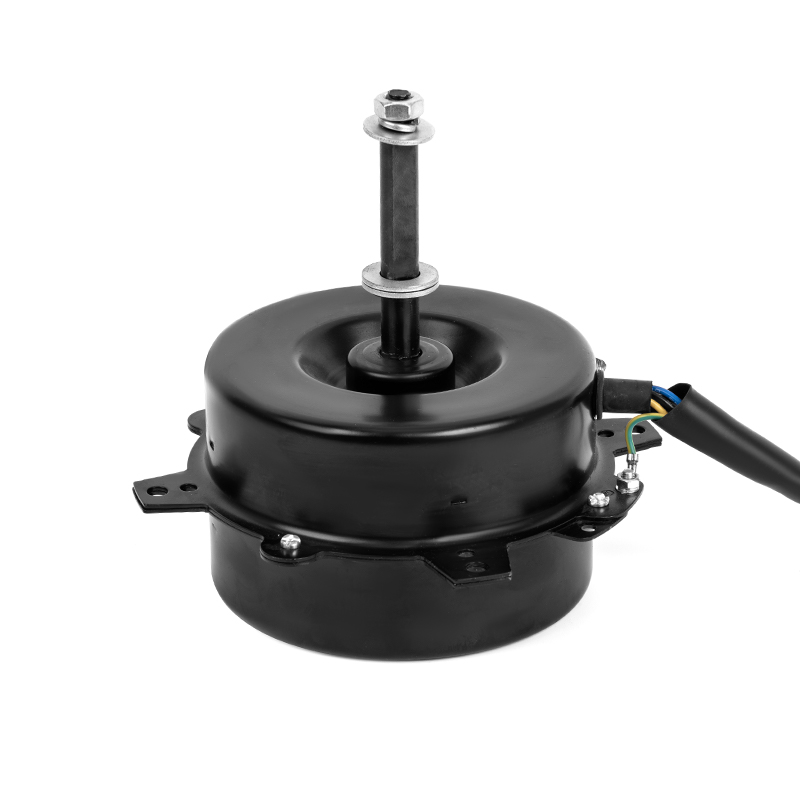
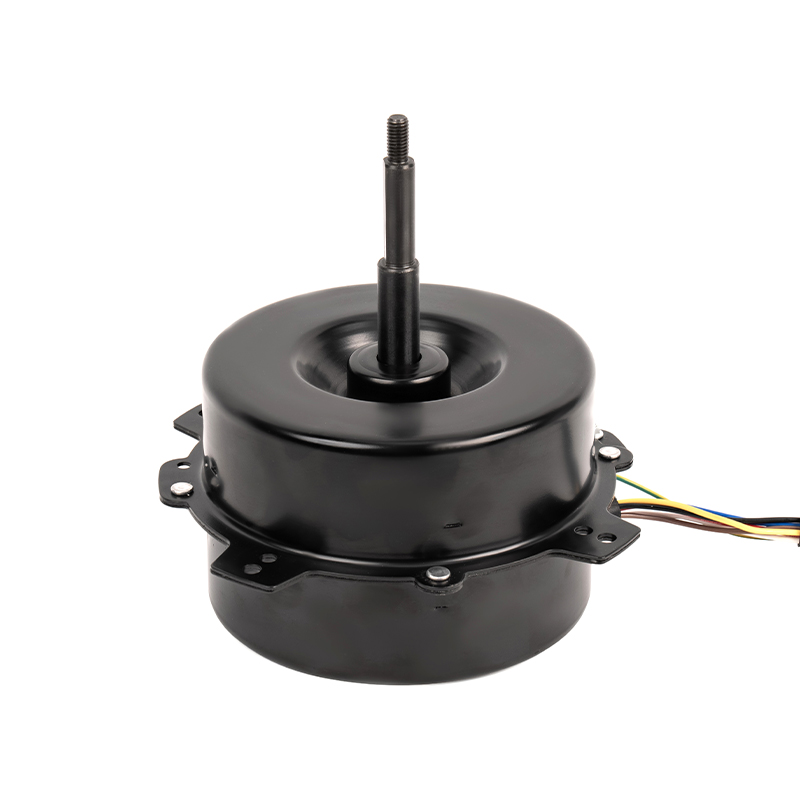
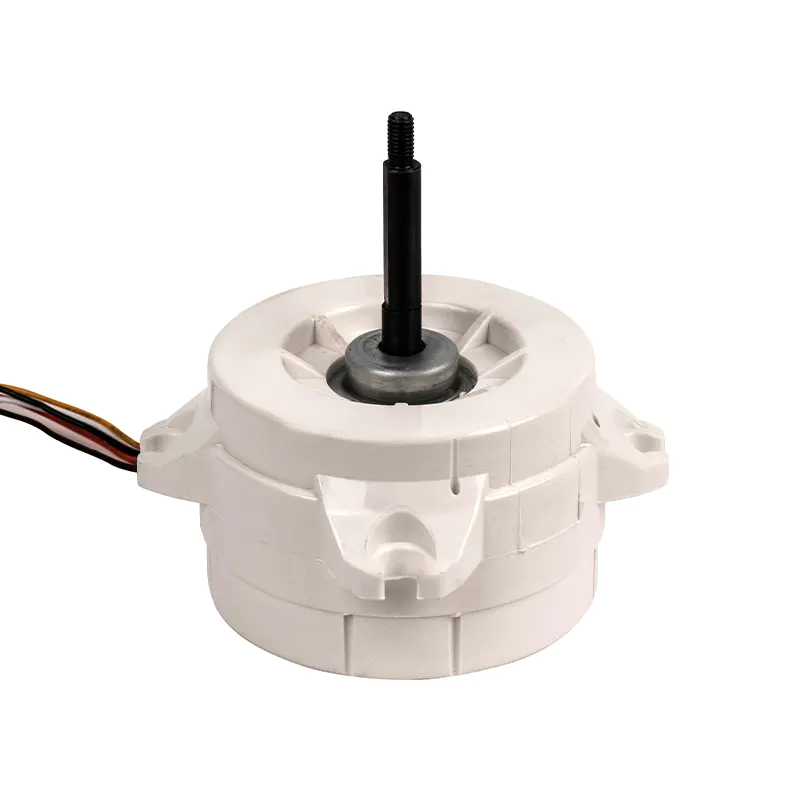 Small Range Hood DC Motor Supplier for Stable AirflowThis supplier listing covers brushless DC motors suited for range hoods, where closed-loop speed control helps maintain airflow under duct resistance, filter loading, and voltage variations. Useful for comparing efficiency and motor-driver options.View Product →
The efficiency advantage over a traditional AC motor widens at partial speed, which matters in a product that runs for hours. The range hood DC motor efficiency comparison covers the numbers under realistic cooking loads, and the AC and DC motor catalog lists tested motor-driver pairs for these applications.
Measured outcome: a matched motor-driver pair with closed-loop PWM draws less power at partial speed than a phase-controlled AC motor, while generating less heat inside the appliance. Both effects improve energy test results and the life of nearby components.
DC motor variable speed is not a single-component decision. The motor, the PWM driver, and the thermal behavior at minimum speed act as one system, so the specification must treat them that way. Define the speed range first, verify torque against the real impeller, choose the controller from the same supplier, and test under the real duty cycle. That discipline is what turns a promising motor on paper into a reliable product in the field.
 ++86 13524608688