

 English
 عربى
عربىElectric Motor Brushes: The Smallest Part That Decides Motor Life
How brush grade, spring pressure and commutator condition set the service interval of small appliance motors, and when a brushless design removes the question altogether.
A cooling fan that runs at half speed, a heater blower that crackles behind the grille, a range hood that buzzes before it catches: in a large share of returned small appliances the winding is sound and the brushes are finished. The carbon blocks cost very little, yet they decide the maintenance interval of the entire product.
Brushes are not a fault to be engineered out at any cost. They are a controlled wear interface, and each one rewards the right grade, the right spring pressure and a disciplined inspection habit. Managing those three variables is usually cheaper than moving a product to a different motor technology.
What an Electric Motor Brush Actually Does
The short answer: a brush is a replaceable current-transfer contact that wears on purpose so the commutator does not have to be replaced. It carries current from a stationary terminal to the rotating armature through sliding contact, and it is expected to lose material while doing that job.
Every brush specification balances three competing needs:
- Contact stability, so the brush stays seated on the commutator through vibration and speed changes.
- Friction budget, high enough for conduction, low enough to limit heat and mechanical wear.
- Current density, small enough to keep the motor compact, large enough that the brush does not overheat.
In small appliance motors, spring pressure commonly falls in the 15 to 30 kPa band, and carbon-graphite grades usually run at roughly 8 to 12 A/cm². Treat those as starting points, because the figure that matters is the one your own life test produces. For the current path itself, this note on commutator and brush functions in a DC motor covers the sliding interface in more detail.
Brush Grades: Small Material Changes, Large Life Differences
Brush selection is a materials decision long before it becomes a purchasing decision. Four families cover most small-motor work, and the gaps between them appear as wear rate, dust volume and tolerance to arcing.
| Grade | Composition | Current density guide | Wear behaviour | Typical small-motor use |
|---|---|---|---|---|
| Carbon-graphite | Carbon powder with graphite | 8-12 A/cm² | Moderate wear, forms a stable film, tolerates light arcing | General purpose DC and universal motors, cooling fan and blower motors |
| Electrographite | Graphitised carbon, harder bond | 10-15 A/cm² | Slower mechanical wear, runs cooler at higher speed | High-speed blowers, continuous-duty fan motors |
| Metal-graphite (copper) | Copper and graphite powder | 20-30 A/cm² | Faster wear, very low voltage drop | Low-voltage DC motors, high starting current |
| Resin-bonded carbon | Carbon with resin binder | 6-10 A/cm² | Softer, more dust, shorter life | Light-duty intermittent appliances |
Info
A copper-rich brush lowers contact voltage drop and helps cold starting, but the same copper content softens the material and shortens life under continuous load. When a motor starts perfectly and then wears quickly, grade is usually the first suspect rather than the mechanism.
What Actually Shortens Brush Life in the Field
Datasheet life figures assume a clean bench and a steady load. Real installations change several conditions at once.
- Spring pressure drift. A spring that loses force with heat reduces contact, raises resistance and starts the arcing that damages both brush and commutator.
- Humidity swings. Very dry air thins the beneficial contact film, while very humid air encourages copper oxide and rougher running.
- Oil mist and fine dust. Kitchen and workshop appliances pull aerosol through the motor path, and a conductive dust film can bridge the brush holder to the housing.
- Overload and low voltage. A dragging fan blade or a long undervoltage period raises current, and current raises brush temperature.
- Commutator condition. Runout, uneven brush tracks and rough segment edges machine the brush from the side instead of the face.
- Duty cycle. The same brush in an intermittent heater motor and in a continuous cooling fan motor will produce two very different service intervals.
A brush is designed to disappear in a controlled, predictable way. When it disappears quickly, the brush is rarely the first thing that changed in the system.
Symptoms That Point to Brushes Rather Than a Winding
Warning
Blue-white arcing visible through the housing vents, a sharp ozone smell, or a motor that only starts after a light tap all indicate a brush or commutator fault. Stop the test run and inspect before the commutator surface is scored beyond recovery.
- Black carbon dust packed around the brush holder, with a glazed or streaked commutator underneath.
- Speed fluctuation that becomes obvious under load but almost disappears at no load.
- Uneven brush length across the pair, which points to a sticking holder or a weak spring rather than a bad grade.
- Sparking concentrated on one or two commutator segments, which usually means a segment fault rather than the brush itself.
- A housing that runs noticeably hotter after the same operating time than it did when the motor was new.
Brushed or Brushless: Matching the Design to the Load
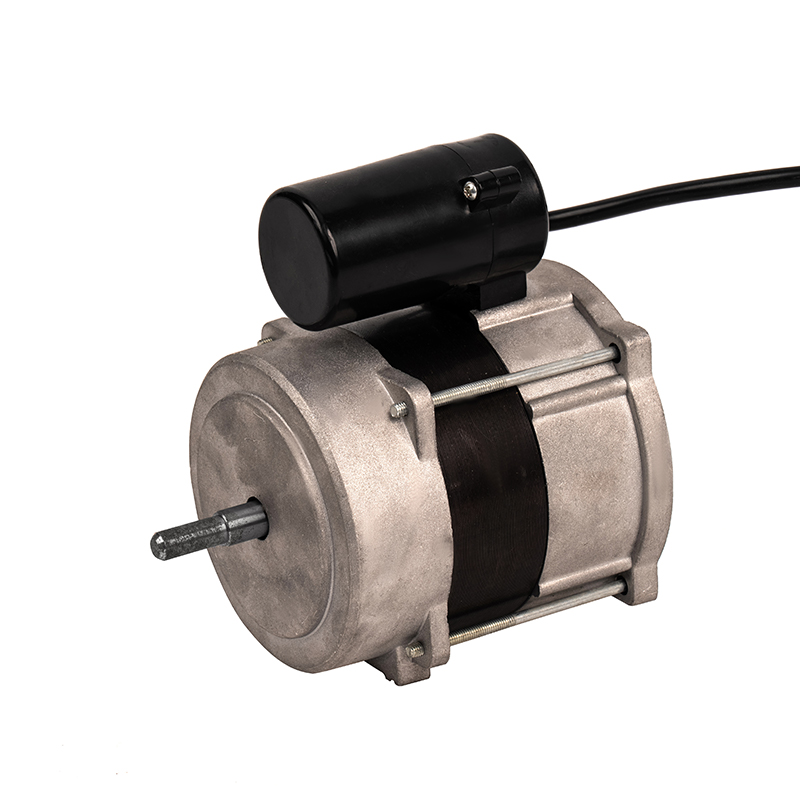
A single-phase capacitor-run asynchronous motor has no brushes at all, because the rotor current is induced rather than conducted. That is why fixed-speed fan and heater appliances often avoid the wear interface entirely, along with the carbon dust that comes with it.
If the appliance runs for long hours at a fixed speed and the user never opens the housing, an AC induction design removes both the wear part and the dust path. If the product instead needs stepless speed control, such as a range hood that ramps between quiet extraction and boost, a DC platform is the practical answer, and the brushless version keeps fine control without the carbon residue.
The decision is rarely about modern versus old technology. It comes down to duty cycle, maintenance access and whether the appliance truly needs variable speed. A wider view of how these families divide is covered in this overview of main categories of motors.
Replacing Brushes Without Creating a Second Failure
Replacement is a short job that usually fails at the rework stage rather than at the bench. Work through the sequence in order.
- Isolate the supply and confirm zero energy before the housing is opened, then photograph the brush orientation and lead routing.
- Read the commutator first: colour, track width, segment edges and runout tell you whether new brushes will survive or simply wear out again.
- Measure remaining brush length against the wear line, commonly 60 to 70 percent of new length or the manufacturer's marked limit.
- Check the brush holder. The brush must slide freely; a holder clogged with carbon dust tilts the brush and produces edge contact and sparking.
- Measure spring force instead of assuming it, and replace springs together with brushes rather than one or the other.
- Bed in the new brushes at light load for 30 to 60 minutes so the face matches the commutator curvature before full current is applied.
Verify the result with three readings: current draw at rated voltage, housing temperature after half an hour, and sparking at the brush edge at both no load and full load. A replacement that draws more current than the original is not finished yet.
What to Verify Before Approving a Motor Supplier
For appliance makers, brush life is a warranty number rather than a maintenance item, so the checks that matter are mostly about batch consistency:
- Brush length tolerance and holder clearance on samples from each production lot, not from the golden sample.
- Spring force measured on a sampling basis, since force drift is invisible in a finished motor until it fails.
- No-load current and speed at rated voltage, recorded as an end-of-line value for every unit.
- Commutator surface condition and dust clearance after run-in, which shows whether the assembly process is clean.
- Documented life or accelerated tests, plus the conformity evidence behind claims such as CCC/CQC self-declaration and CE marking.
Success
Ask for the end-of-line test record rather than a certificate list. A supplier who can show measured current, speed and spring force data per batch has already solved most of the brush-life problem in production.
Where an appliance pulls oil mist and moisture through the motor path, a sealed or encapsulated structure removes much of the contamination that destroys brushes and bearings alike, which is often the more durable route for kitchen equipment.
Electric motor brushes sit in an awkward position: cheap enough to be ignored in a bill of materials, decisive enough to define the warranty cost of a fan, a heater or a hood. The practical rule is simple. Choose the grade for the environment, set the spring force for the duty cycle, inspect the commutator before blaming the carbon, and when the load is fixed and the housing is sealed, consider removing the wear interface from the design instead of managing it in the field.
 ++86 13524608688